
Identify the top 1% Software Engineers
Objective skill evaluation
Assesses candidates based on actual coding ability, not resumes or self-reported skills.
Scales effortlessly
Evaluate hundreds of developers simultaneously without manual intervention.
Standardized and fair
Every candidate is tested on the same problems under the same conditions.
Faster hiring decisions
Auto-scored results and detailed insights speed up shortlisting.
Role-relevant testing
Coding challenges are tailored to specific tech stacks and job requirements.
What Hiring Teams Say
We received close to 300 resumes, and using Babblebots we were able to bring that down to just 10 final candidates. We completed the entire hiring exercise in less than 24 hours.
FAQs
Babblebots AI-Interviewer, can in a single 15–30 minute video AI interview, evaluate hard skills, soft skills like language, and confidence to give you a curated shortlist and stack ranked candidates.
The final decision is always taken by humans. Forward thinking and innovative companies are using this as a way to shortlist and hire talent, at the speed of AI.
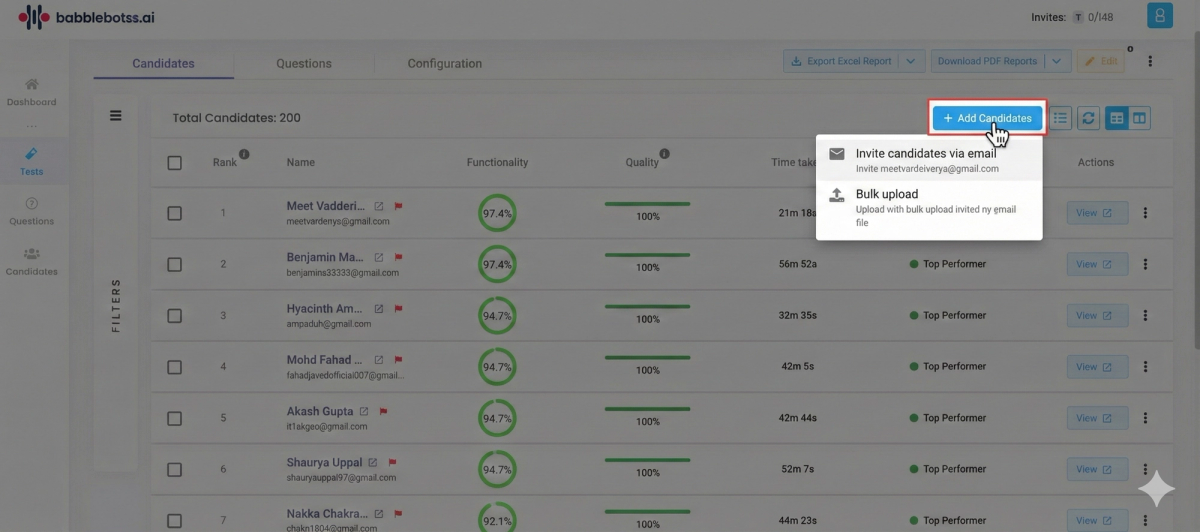
Babblebots AI Coding Assessment is an enterprise-grade coding assessment platform designed to help companies identify the top 1% of software engineers with speed, objectivity, and scale. Modern technical hiring is broken at the first screening stage: teams rely heavily on resumes, self-reported skills, keyword matching, and subjective interviewer judgment. As a result, recruiters waste hours screening unqualified candidates, engineering managers spend time on early-stage interviews that should have been filtered automatically, and organizations struggle to maintain fairness and consistency across evaluations. Babblebots solves this problem with an AI-powered coding assessment platform that allows hiring teams to evaluate 100+ technical skills across thousands of candidates in a single day. Instead of relying on resumes alone, companies can deploy structured online coding tests, role-based technical challenges, and automated scoring workflows that surface only interview-ready candidates. This dramatically reduces manual technical screening effort while increasing accuracy and consistency. The platform is built for high-volume developer hiring, enterprise engineering recruitment, and scaling technical teams across multiple roles and tech stacks. Whether hiring backend engineers, frontend developers, full-stack engineers, data engineers, DevOps professionals, or specialized domain experts, Babblebots provides structured, objective skill evaluation through AI-driven coding assessments. At the core of the product is a simple promise: identify the top 1% of software engineers faster and more reliably than traditional hiring methods. The hero positioning emphasizes deep technical evaluation at scale. Hiring managers no longer need to manually review every GitHub profile, conduct repetitive introductory interviews, or rely on intuition about candidate capability. Instead, Babblebots runs automated coding tests under standardized conditions, analyzes results consistently, and provides clear scoring insights that support confident hiring decisions. One of the most critical value points presented on the page is the measurable reduction in manual effort. The platform claims a 60–70% reduction in manual technical screening time. This is achieved by automating early-stage skill validation, removing unnecessary recruiter calls, and eliminating repeated basic technical questions. Instead of spending hours reviewing resumes and scheduling early assessments, recruiters can focus only on shortlisted, high-signal candidates. In addition to reducing workload, Babblebots increases technical shortlisting speed by 2×. This means hiring teams can move candidates through the funnel faster without sacrificing evaluation depth. Faster shortlisting translates into shorter time-to-hire, improved candidate experience, and reduced offer drop-offs — especially important in competitive engineering markets where top talent is often evaluating multiple offers simultaneously. Consistency is another foundational pillar of the platform. Babblebots highlights 100% consistent assessment conditions. Every candidate receives the same evaluation environment, the same challenge structure, and standardized scoring criteria. This removes subjectivity and reduces bias, ensuring fair comparison across applicants. In technical hiring, inconsistency in interviews often results in false positives or false negatives. Standardization ensures that skill evaluation is based on performance under controlled conditions rather than interviewer style or mood. The section titled “Identify the top 1% Software Engineers” outlines five structured benefits that directly align with high-intent commercial keywords like coding assessment platform, technical assessment software, AI coding assessment software, and automated coding test software. First, Objective Skill Evaluation. Babblebots evaluates candidates based on actual coding ability, not resumes or self-reported expertise. This is crucial because resumes frequently exaggerate experience, and keyword-based filters miss nuance in real capability. The platform tests real programming skills through structured challenges, enabling hiring teams to distinguish true proficiency from resume polish. Second, Scales Effortlessly. The system is built to evaluate hundreds or thousands of developers simultaneously without manual intervention. This is essential for companies running large hiring drives, campus recruitment programs, remote hiring initiatives, or enterprise expansion. Scalability ensures that growth in applicant volume does not proportionally increase recruiter workload. Third, Standardized and Fair. Every candidate is tested on the same problems under identical conditions. This removes bias, increases fairness, and ensures that decisions are data-driven. Structured assessments protect against inconsistent interviewer evaluation and create defensible hiring decisions. Fourth, Faster Hiring Decisions. Automated scoring, structured insights, and role-based skill mapping allow recruiters and hiring managers to quickly identify top candidates. Instead of manually comparing subjective notes, teams receive data-backed performance results that support confident shortlisting. Fifth, Role-Relevant Testing. Coding challenges are tailored to specific tech stacks, job roles, and difficulty levels. A backend engineer can be assessed differently from a frontend specialist or data engineer. This customization ensures that evaluation aligns with real-world job requirements rather than generic algorithm puzzles. The testimonial section reinforces these benefits with a concrete real-world example. A hiring team reportedly received close to 300 resumes and used Babblebots to narrow that down to just 10 final candidates. The entire hiring exercise was completed in less than 24 hours. This demonstrates not only speed but also signal clarity — transforming a high-volume applicant pool into a manageable shortlist in one day. This example reflects the platform’s positioning as both a technical assessment software and a developer hiring platform capable of handling urgent hiring needs. From an enterprise perspective, Babblebots fits into the broader technical recruitment ecosystem. It supports structured hiring workflows and integrates into recruitment pipelines as a screening layer before final interviews. Organizations using ATS systems, recruiting CRM platforms, or structured hiring frameworks can incorporate Babblebots as the technical validation stage. In terms of commercial search intent, the page naturally aligns with high-value keywords including: • coding assessment platform • technical assessment software • online coding test platform • developer assessment tool • AI coding assessment software • automated coding test software • programming skills assessment • remote coding assessment • technical screening software • developer hiring platform • engineering hiring software • enterprise coding assessment platform • coding test API These keywords represent real SaaS buyer intent, particularly from recruiters, talent acquisition leaders, engineering managers, and CTOs seeking scalable evaluation solutions. The FAQ section addresses common buyer concerns that frequently influence purchasing decisions. One FAQ clarifies what an AI coding assessment is. It positions the product as a structured technical evaluation that measures real coding ability rather than theoretical knowledge or resume claims. Another FAQ explains what skills the platform can assess. It reinforces the claim of 100+ skills and role-specific customization, which supports the platform’s scalability and flexibility across different engineering domains. A question about customization confirms that assessments can be tailored to different roles, tech stacks, and difficulty levels. This is critical for enterprise adoption, where hiring needs vary widely across departments. The FAQ also addresses how candidates are evaluated, reinforcing the objectivity and automated scoring mechanism. Finally, a question about suitability for large-scale tech hiring reassures enterprise buyers that the system is built for volume. The call-to-action structure is intentionally dual-layered. A “Start a Free Trial” option provides lower-friction entry for teams wanting to experiment with the platform. A “Book a Demo” option targets enterprise buyers who require guided onboarding, integration discussions, or custom workflow setup. The closing headline, “Hire for skills and attitude, with AI,” reinforces the overarching philosophy of the product: move beyond resume filtering and subjective interviews toward data-driven technical validation. From a strategic standpoint, Babblebots AI Coding Assessment is not just an online coding test platform — it is a full technical screening acceleration engine. It compresses the hiring funnel by validating capability early, reducing manual workload, and creating consistent evaluation standards. For organizations struggling with: • Slow engineering hiring • Inconsistent interview standards • Resume overload • High-volume campus hiring • Remote technical hiring • Scaling developer teams Babblebots provides a structured solution. It enables hiring teams to: • Evaluate hundreds of candidates simultaneously • Automatically score coding performance • Compare candidates objectively • Reduce recruiter effort by up to 70% • Shortlist engineers 2× faster • Maintain 100% consistent testing conditions Ultimately, Babblebots AI Coding Assessment transforms technical hiring from a manual, inconsistent, and time-consuming process into a structured, scalable, and intelligent system powered by AI. By combining automation, objective evaluation, and enterprise-grade scalability, it empowers companies to identify top engineering talent faster — without sacrificing fairness, depth, or quality.
Babblebots AI Coding Assessment is a coding assessment platform built for modern technical hiring, where speed, quality, and fairness matter as much as scale. Hiring teams often face the same pain: a high volume of applicants, inconsistent interviewer bandwidth, and a screening process that becomes slow, subjective, and exhausting. This product page showcases how Babblebots replaces that bottleneck with a structured, measurable technical assessment workflow—so companies can evaluate software engineers quickly, consistently, and objectively, without relying on gut-feel screening or resume-only decisions. At the top of the experience, the page positions the product as an AI Coding Assessment solution designed to assess candidates “deeper technically,” at scale. The promise is clear: evaluate 100+ skills across thousands of candidates in a single day and hire with confidence. That positioning aligns directly with high-intent buyer searches such as technical assessment software, coding assessment platform, online coding test platform, developer assessment tool, automated coding test software, and AI coding assessment software. In other words, it sits inside the exact commercial category where buyers compare tools like HackerRank, Codility, and CodeSignal—then differentiates with speed, consistency, and hiring-readiness. The core workflow implied by the product UI is straightforward and enterprise-friendly: create or configure a technical assessment, invite candidates, run role-based coding challenges at scale, and get scored results that help recruiters and engineering managers shortlist the right people. The page supports this with concrete operational outcomes. It highlights a 60–70% reduction in manual technical screening time (framed as reduction in manual effort), 2× faster technical shortlisting speed, and 100% consistent assessment conditions. Those three metrics are important because they map to real buying intent: teams want faster time-to-hire, lower recruiter workload, and standardized evaluation that reduces bias and noise across interviewers. The “Identify the top 1% Software Engineers” section anchors the benefits into five practical pillars that match how technical screening software is evaluated in procurement and in day-to-day recruiting operations: Objective skill evaluation: Babblebots assesses candidates based on actual coding ability rather than resumes or self-reported skills. This aligns with programming skills assessment and developer assessment tool intent, and it’s what teams mean when they search for technical assessment software that can replace early-round interviews. Scales effortlessly: The platform is positioned for high volume evaluation—testing hundreds or thousands of developers simultaneously without manual intervention. That is the differentiator for teams hiring aggressively, as well as for enterprises needing consistent, repeatable screening. Standardized and fair: Every candidate is tested on the same problems under the same conditions. This is the “100% consistent assessment conditions” promise operationalized. It matters because inconsistent screening creates false positives/negatives, increases drop-offs, and introduces bias. Faster hiring decisions: Automated scoring, structured reports, and clear skill signals speed up shortlisting and reduce time spent in back-and-forth reviews. This directly supports the “2× faster” positioning and maps to terms like automated coding test software and remote coding assessment. Role-relevant testing: Assessments can be tailored to specific tech stacks and job requirements, ensuring relevance for different engineering roles. That matches real-world purchase criteria: buyers don’t want generic puzzles; they want role-based coding challenges that reflect real work. The page also includes a strong real-world testimonial that reinforces the scale and speed narrative. It states that a team received close to 300 resumes and used Babblebots to bring that down to just 10 final candidates, completing the entire hiring exercise in less than 24 hours. This is exactly the type of proof that increases conversion for buyers evaluating a developer hiring platform: it connects the software output (scores + shortlist) to an outcome leadership cares about (faster hiring with fewer resources). On usability and adoption, the page is designed for recruiters and engineering managers alike. Recruiters get a predictable, repeatable screening layer that reduces manual follow-ups and reduces dependence on scheduling early calls. Engineering managers get a consistent evaluation signal without having to spend hours doing first-round interviews. This is also why the page’s CTA structure matters: it offers a “Start a Free Trial” action for lower-friction evaluation, and a “Book a demo” CTA for teams who want enterprise onboarding, custom workflows, or higher-volume testing. Both are standard for high-intent SaaS pages targeting commercial keywords like coding assessment platform, technical assessment software, and enterprise coding assessment platform. The FAQ section is built around buyer objections and onboarding questions that commonly decide whether a technical screening product makes it into a shortlist. It addresses what an AI coding assessment is, what skills the tool tests, whether assessments can be customized for different roles (which reinforces the “role-relevant testing” pillar), how candidates are evaluated (reinforcing the objective scoring promise), and whether it is suitable for large-scale tech hiring (reinforcing scale). Together, these FAQs create topical coverage for search engines and for LLM-based retrieval, while also reducing friction for decision-makers comparing options. From an SEO intent standpoint, the page should be treated as a “money page” aligned to the highest commercial cluster: coding assessment platform (primary), technical assessment software, online coding test platform, AI coding assessment software, and automated coding test software. Secondary terms that should appear naturally in copy (and in internal linking strategy) include developer assessment tool, programming skills assessment, technical screening software, developer hiring platform, engineering hiring software, enterprise coding assessment platform, and coding test API—especially if the product supports integrations or programmable workflows. If you create adjacent comparison pages later (e.g., “HackerRank alternative,” “Codility alternative,” “CodeSignal alternative”), this page becomes the central product hub to which those competitor-intent pages link, consolidating authority and improving rankings for the core product terms. Babblebots AI Coding Assessment is positioned as a scalable online coding test platform and technical assessment software that compresses technical screening time, improves consistency, and helps teams reliably identify top engineering talent. It’s designed for high-volume hiring, role-based evaluation, and faster decisions—so you can shortlist better candidates with less manual effort, and move from applicants to interview-ready finalists faster than traditional screening.
Tags: AI coding assessment, coding assessment platform, technical assessment software, online coding tests, developer assessment tool, programming skills assessment, automated coding tests, technical screening, engineering hiring, role-based coding challenges, enterprise technical hiring, consistent evaluation, remote coding assessment, scalable assessments, candidate scoring, shortlisting automation
Entities: Babblebots, HackerRank, Codility, CodeSignal, Greenhouse, Lever, Ashby, Workable, Eightfold, ATS, technical assessment, coding tests, candidate scoring, shortlisting, engineering hiring, recruitment automation
Questions: What is an AI coding assessment? | What skills can Babblebots test in a coding assessment? | Can I customize assessments for different engineering roles and tech stacks? | How does candidate scoring and ranking work? | Is Babblebots suitable for large-scale tech hiring? | How fast can we shortlist candidates using this platform? | How do online coding tests improve hiring quality vs resume screening? | Does Babblebots support remote coding assessments?
Takeaways: Objective skill evaluation using coding tests, not resumes | 60–70% reduction in manual technical screening effort | 2× faster shortlisting with structured scoring | 100% consistent assessment conditions across candidates | Role-based coding challenges tailored to tech stacks and levels | Scales to thousands of candidates for high-volume technical hiring | Designed for recruiters + engineering managers to speed decisions | Clear outputs that convert applicants into interview-ready finalists