
If you're on a hiring team or as a top HR executive, you're supposed to screen at scale, onboard efficiently, and get positions filled faster. Meanwhile, you're stuck juggling innumerable administrative tasks and somehow predicting attrition patterns. Surprisingly, much of this sophistication is transformed by the modern AI HR tools.
They reduce human error, streamline decision-making, and automate mundane tasks. In addition, these tools enable you to concentrate on what really matters: your people. Because of this, HR professionals can spend more time on strategy, engagement, and culture-building instead of paperwork and scheduling.
Discover top HR AI tools that automate recruiting, onboarding, and talent management. Compare features, benefits and use cases for HR teams.
AI Tools for HR: What Are They?
AI tools for HR are software programs that businesses use to improve, expedite, and automate human resources procedures.
What they are capable of, briefly:
- Examine thousands of resumes in a matter of seconds. Your hiring team will be able to shortlist the best applicants more quickly and accurately as a result.
- Examine job descriptions for bias. Therefore, before posting roles, you can spot and fix gendered or exclusionary language.
- Automate payroll and onboarding processes. Additionally, new hires save hours of manual labor by automatically receiving credentials, documentation, and training materials.
- Estimate skills gaps and turnover risk. Indeed, artificial intelligence tools predict possible attrition. Throughout the employee lifecycle, they use AI, ML, and NLP for tasks like learning, onboarding, analytics, candidate screening, and engagement.
- Customize career paths and training. In the meantime, learning paths are customized by the system according to roles, interests, and performance patterns.
- Create compliance reports that are ready for an audit. Lastly, without having to compile data repeatedly, your HR team is still completely ready for audits.
By combining automation with intelligence, these tools return hours to HR teams and elevate decision quality.
Categories of HR AI Tools
Discover the best AI tools for HR that automate hiring, onboarding, payroll, and workforce planning. Compare features, benefits, and use cases for HR teams.
- Admin, Content, and Communication Tools: Tools such as ChatGPT, DeepSeek, Claude, Microsoft Copilot, and Perplexity are the leading AI tools used by teams for creating content, company documents, emails, and job descriptions.
- Talent Acquisition
- Applicant Tracking Systems (ATS): These tools, powered by AI are used by companies to manage job postings across various roles and sort and track resumes or applications and more.
- AI Interview and Screening Platforms: These platforms, such as Babblebots AI, use AI agents who source, screen, interview, and assess candidates using human-like conversations.
- Core HR: HR Management Systems (HRMS) are used to manage, optimize, and personalize core HR processes such as employee onboarding, payroll, leave and attendance, and more.
- Employee Experience and Support: HR Chatbots and Virtual Assistants are used to handle employee queries, automate ticketing, administrative tasks, and more. These connect back to the HRMS and help reduce the admin load on the HR teams.
- Workforce Planning: These tools leverage predictive analytics and scenario modeling to forecast headcount needs, manage skill gaps, and anticipate attrition. Deloitte’s 2025 Human Capital Trends report found that organizations using AI for workforce planning achieved 20-25% higher forecasting accuracy and 15% faster project staffing.
What Can HR AI Tools Actually Do?
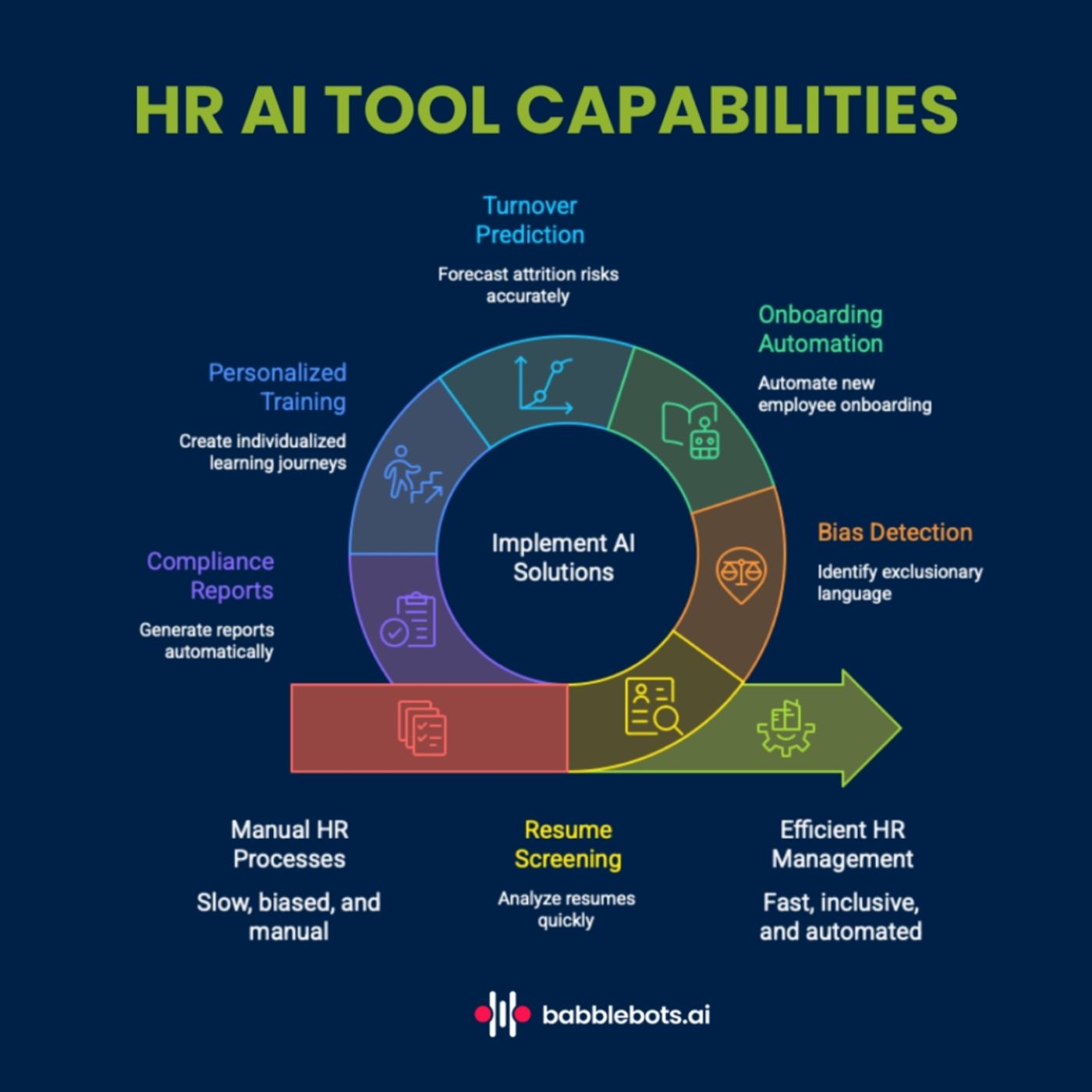
Modern AI tools for HR are changing how HR professionals work by saving time, improving decision quality, and reducing bias across various processes.
- They analyze thousands of resumes in seconds. As a result, hiring teams can screen candidates up to 75% faster compared to manual review.Recently, a LinkedIn Talent Solutions (2024) study found that AI-driven resume parsing reduced recruiter workload by 30 hours per month on average, allowing them to focus more on interviews and candidate experience.
- AI candidate screeners also detect bias in job descriptions and moreover they identify gendered or exclusionary language before postings go live. According to a 2023 Textio Report, companies using bias-detection AI saw a 21% increase in female applicant ratios and a 13% rise in minority candidate engagement. In addition, this ensures your communication remains inclusive and aligned with organizational values.
- Automate onboarding and payroll. This means new employees receive credentials, forms, and training automatically. Furthermore, automation reduces manual paperwork and speeds up the onboarding cycle.
- Predict employee turnover. Predictive analytics can now forecast attrition risk with up to 85% accuracy, based on behavior, performance, and sentiment data.As per the 2025 NASSCOM Future of Work Study, organizations using predictive HR analytics achieved an 18% reduction in annual turnover within one year of implementation.This insight enables HR leaders to take timely preventive action and strengthen retention programs.
- Personalize training and career paths. AI creates individualized learning journeys based on each employee’s role, skill set, and growth goals. This keeps employees more engaged and motivated to develop.
- Generate compliance reports automatically. As a result, organizations stay audit-ready without hours of manual data compilation.Additionally, IBM’s HR Automation Case Study (2023) found that AI-driven compliance reporting reduced errors by 28% and improved audit response times by 40%.Consequently, HR teams gain greater confidence in data integrity and regulatory readiness.
By combining automation with intelligence, AI tools free up HR teams from repetitive work. This allows professionals to focus on what truly matters: the people.
How to Choose the Right AI Tools for HR?
How to Choose the Right AI Tools for HR?
1. Start With Your Biggest Pain Point
Don't try to implement everything at once. Instead, identify your most pressing challenge first:
- Taking too long to fill positions? → Focus on recruitment AI tools
- New employees confused and disengaged? → Start with onboarding automation.
- High turnover catching you by surprise? → Invest in predictive analytics.
2. Consider Data Privacy and Compliance
Every organization has its own set of local or global compliance norms, so ensure that the tools you are selecting comply with them. Some of the compliances include GDPR, SOC 2 Type 1 & 2, ISO 27001, ISO 42001, and more.
3. Look for Human-in-the-Loop (HITL) Features
The best AI tools include human oversight. Ensure the platform:
- Allows HR professionals to review AI decisions
- Provides explainable AI outputs
- Flags edge cases for human review
- Includes override capabilities
4. Evaluate Integration Capabilities
System integration can be a deal breaker; most of the AI tools are designed to integrate seamlessly. Check if the AI tool you have selected is integrating easily with your existing set of systems, including HRMS, ATS, communication platforms, L&D systems, and more.
5. Test It Out Before Committing
Additionally, most platforms offer short-term contracts or free trials that allow you to test the tool with real use cases, collaborate with team members who will use it, and measure the impact before going ahead on a long-term mode.
FAQs About AI Tools for HR
What are AI tools for HR used for?
AI tools for HR automate repetitive tasks like recruitment, onboarding, payroll, and performance management. They use machine learning and natural language processing to analyze data, screen candidates, and personalize employee experiences. These tools save time, reduce bias, and improve accuracy throughout the employee lifecycle.
Which is the best AI tool for HR?
The “best” AI tool ultimately depends on your organization’s specific needs. For instance, if your priority is recruitment, Babblebots AI leads the market with advanced interview automation and analytics. Meanwhile, when it comes to comprehensive HRMS platforms, companies such as Rippling and BambooHR truly stand out for their integrated payroll and workforce management capabilities. In addition, if employee engagement is your main focus, Leena AI offers powerful chatbot functionality that enhances communication and employee support. Therefore, it’s advisable to begin by identifying your biggest HR challenge and then choose a tool specifically designed to address that issue.
Are AI tools for HR compliant with data laws?
Fortunately, most leading HR AI platforms are fully compliant with GDPR, SOC 2 Type I & Type II, ISO 42001, and ISO 27001 standards. These certifications are globally recognized and ensure compliance, data privacy, and AI transparency. In addition to that, if there are any local compliance requirements that your company needs to meet, then make sure that is done before going ahead.
Can small businesses afford AI tools for HR?
Yes! Small businesses should start with one tool addressing their biggest challenge, usually recruitment or employee communication. The time savings typically justify the cost within weeks.
How do I implement AI tools in my HR department?
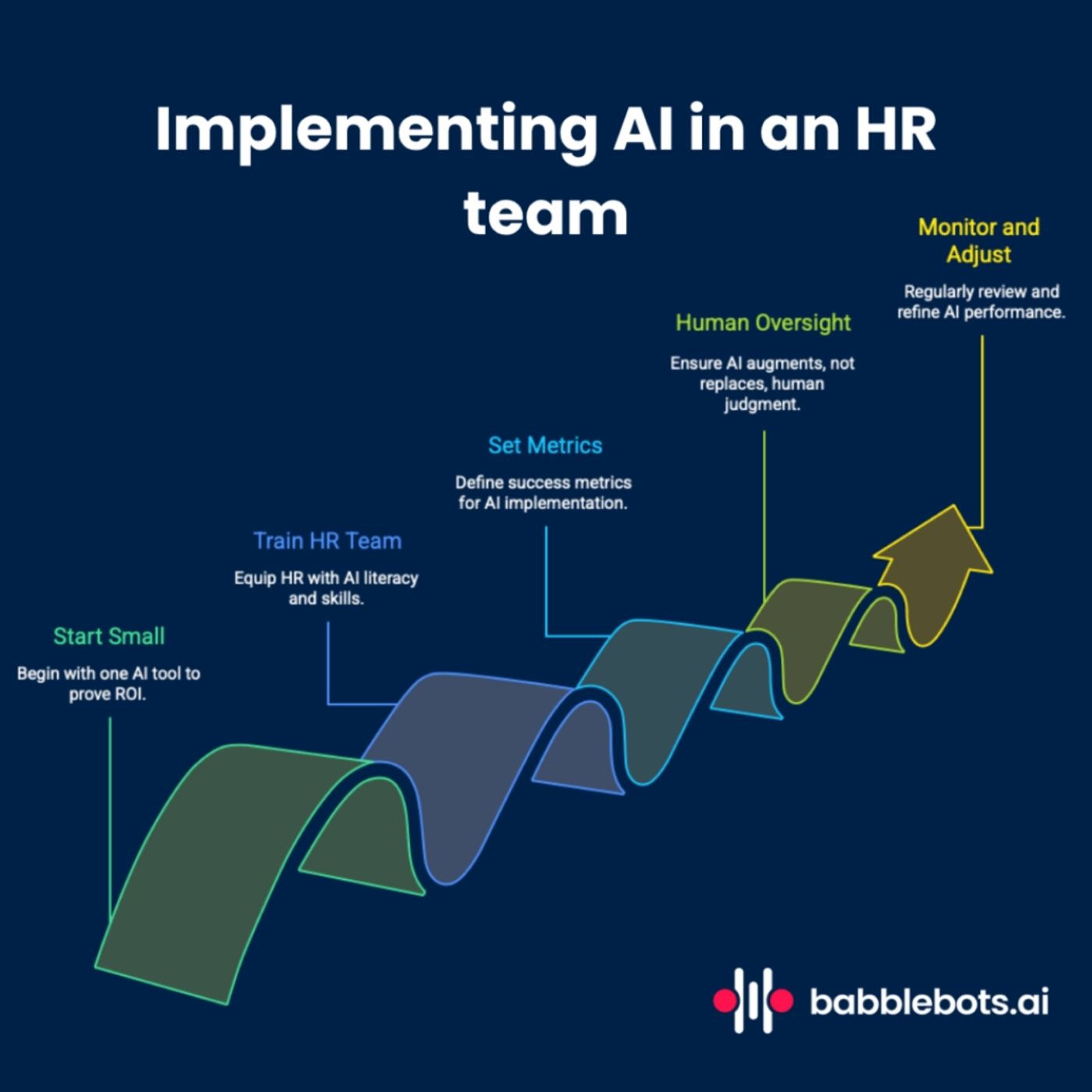
Start small: pick one tool for one function, train your team thoroughly, set clear success metrics, and maintain human oversight. Begin with low-risk applications like resume screening or FAQ chatbots. First prove the return on investment, and then go on to expand to more complex use cases.
Will AI tools replace HR jobs?
No. AI tools will help increase the productivity and efficiency of HR teams by automating the repetitive tasks that consume the major bandwidth of these teams. As a result, HR professionals can focus on strategy, culture, and human connection, work that requires empathy and judgment.
Ready to start? Identify your biggest HR challenge. Is hiring taking too long? Employees disengaged? High turnover? Pick one AI tool designed for that specific problem and start small. The future of HR is here, and it's powered by smart automation.