
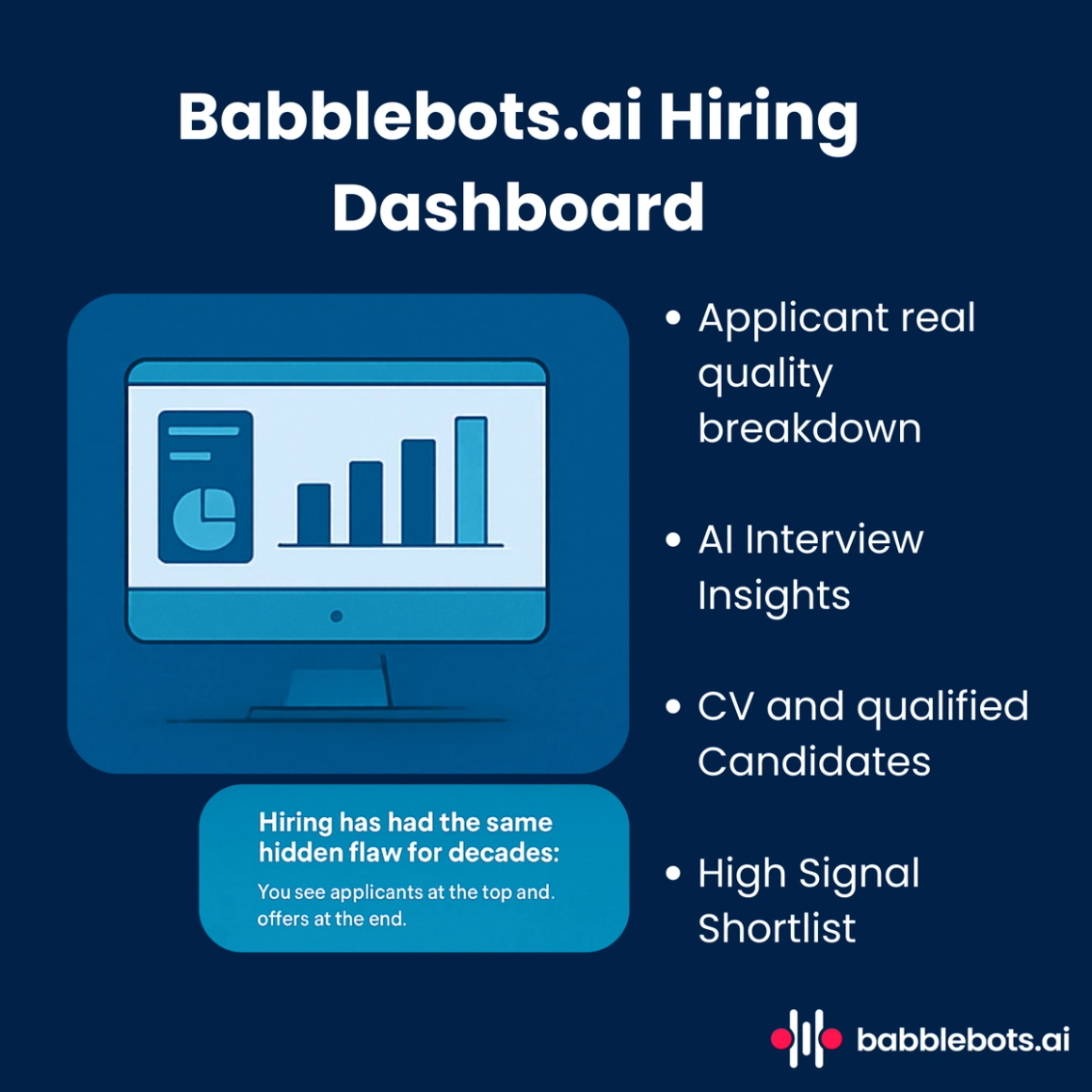
For decades, hiring has suffered from a silent, structural flaw: leaders never knew where great candidates were getting lost.
You see the top of the funnel (applicants) and the very end (offers).
Everything in between? That’s been a black box of manual screening, subjective filtering, inconsistent interviewing, and overwhelming volume.
AI entered hiring, but ironically, most AI tools became black boxes themselves.
So the core question remained:
If AI is screening, interviewing, shortlisting, and scoring candidates… why can’t leaders see what’s actually happening inside the funnel?
That question shaped the architecture of the Babblebots.ai Hiring Transparency Dashboard, a system designed not just to automate recruitment, but to expose its internal physics.
This is the first time hiring stops being guesswork and starts being measurable truth.
In this article we discover how an AI hiring transparency dashboard transforms recruitment from guesswork to ground truth and learn why data-driven funnels are the future of hiring.
The New Level of Hiring Transparency
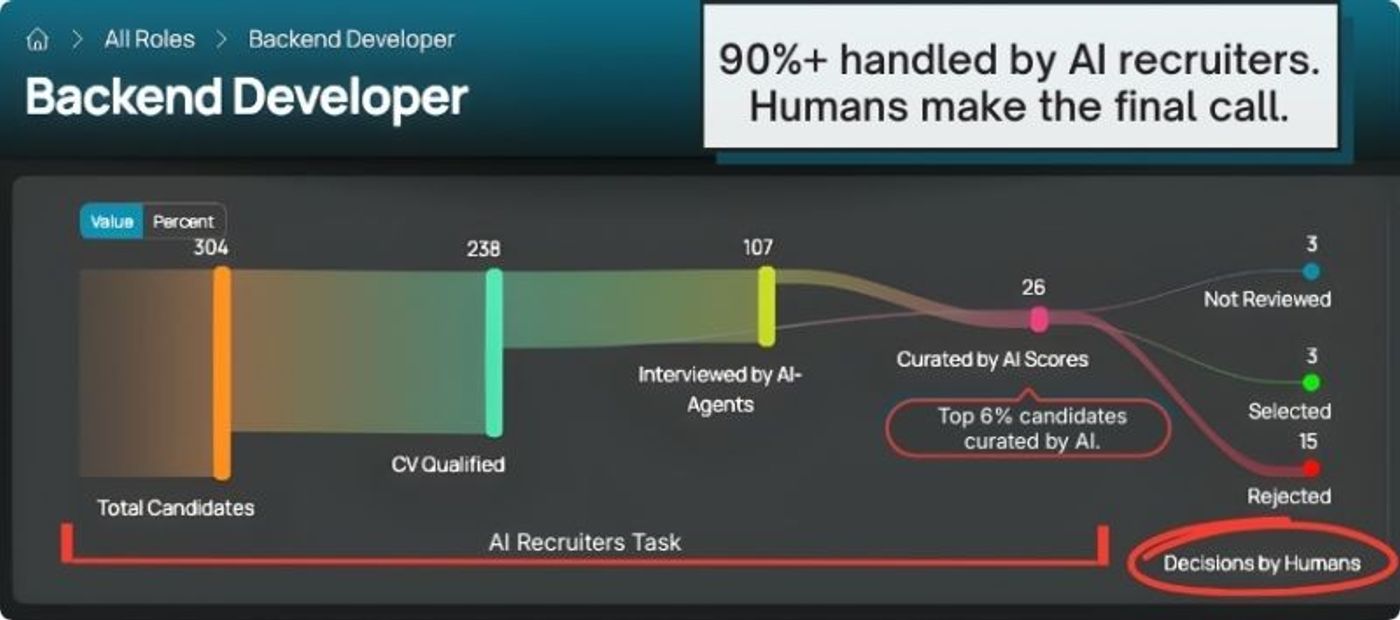
Below is a real funnel example from a recent role we handled for a leading company. Each stage reveals something hiring teams have never been able to see at this resolution before.
1. Total Candidates Who Applied
Most dashboards celebrate “304 applicants” as a success metric.
But high volume doesn’t translate to high quality.
The dashboard breaks this number into:
- Candidates meeting baseline skill thresholds
- Candidates acing the AI interview
- Candidates belonging to the high-signal shortlist
Why this matters:
Hiring is not about collecting CVs.
Hiring is about efficient elimination separating the “definite no” from the “possible yes” at scale.
2. CV-Qualified Candidates
This is where a deeper insight emerges:
Your sourcing strategy may be strong. Your manual screening isn’t.
Traditionally, recruiters lose 40-60% of their time sifting through résumés.
With an AI hiring transparency dashboard:
- Screening becomes instant
- Bias is reduced
- Semantic skill-matching replaces keyword tricks
- High-context patterns are detected early
This single stage recovers days of recruiter time per role-time that can be reinvested into candidate experience and strategic decision-making.
3. Candidates Interviewed by AI Agents
Most hiring teams never interview 100+ candidates for a role.
Not because they shouldn’t but because they can’t.
AI can.
This unlocks a new layer of insight:
- Communication clarity
- Structured thinking
- Problem-solving approach
- Reality vs résumé inflation
- Role alignment tendencies
For the first time, interviews become a data layer-not a bottleneck.
4. Curated Shortlist Based on AI Scores
This is the stage most ATS tools cannot show.
The top 6-10% of candidates emerge through:
- Structured assessments
- Comparative scoring
- Behavioural and semantic analysis
- Technical depth indicators
- Outcome-oriented evaluation
The truth most founders don’t realise:
Hiring isn’t a numbers game.
Hiring is a distribution curve and the right tail is tiny.
Your competitive advantage lies in surfacing that right tail faster than anyone else.
The Babblebots dashboard makes that possible.
5. Final Selections Made by Humans
Babblebots automates ~90% of the hiring process.
But judgment stays human.
Because AI should accelerate decisions, not replace them.
Teams retain full control over:
- Culture fit
- Team chemistry
- Role expectations
- Leadership intuition
- Organisational resonance
AI handles the heavy lifting.
Humans make the final call.
Why This Dashboard Actually Changes Hiring
It exposes the recruitment physics no one could see before.
Every funnel has friction, leakage, drag, and velocity.
Now leaders can pinpoint exactly where quality accelerates and where it drops.
It shifts hiring from reactive → diagnostic.
You’re no longer guessing where inefficiency hides.
You see it: time-to-hire, stage-level conversion, interview quality distribution, sourcing ROI.
It transforms operators into strategists.
When automation handles volume:
Recruiters can focus on storytelling, experience design, and calibration conversations-not admin work.
It institutionalises transparency.
For the first time, executives, recruiters, and managers share the same real-time, stage-by-stage truth.
Why This Matters Going Into 2026
Hiring is now one of the highest costs on the P&L for fast-growing companies.
The era of manual, intuition-driven hiring is over.
Teams adopting AI recruiters and transparent dashboards gain structural power:
- Faster hiring cycles
- Cleaner, high-quality pipelines
- Higher signal density per candidate
- Better final decisions
- Predictable workforce planning
Teams that delay this shift will spend 2026 trying to catch up.
Conclusion: The Future of Hiring Is Transparent
Recruitment used to feel like running a factory with the lights turned off.
Leaders worked hard just not always in the right direction.
The AI hiring transparency dashboard switches the lights on.
You don’t just automate hiring.
You understand it.
You don’t just move faster.
You move smarter.
And in 2026, the teams with the clearest view of their talent engine will win.