
How AI Is Transforming Campus Recruitment in 2026
Campus recruitment is uniquely suited for AI transformation. High candidate volumes, standardized qualification requirements, tight timelines, and the need for fair unbiased evaluation make it an ideal use case for AI-powered hiring tools. In 2026, organizations using AI in campus drives are hiring 3x faster, screening 10x more candidates, and building more diverse teams while reducing recruiter burnout.
Why Campus Recruitment Needs AI
The Volume Challenge
A single campus drive can generate 500 to 5,000 or more applications for 50 to 100 positions. Manual screening of this volume requires weeks of recruiter time, creating delays that cause top candidates to accept other offers. The math is straightforward: if each phone screen takes 20 minutes plus 10 minutes of scheduling, screening 1,000 candidates requires 500 hours of recruiter time.
The Speed Challenge
Campus hiring happens in compressed timelines. Companies visiting 10 to 20 campuses in a season need to screen, evaluate, and extend offers within days. The best candidates receive multiple offers, so speed directly impacts offer acceptance rates. A 48-hour advantage over competitors can mean the difference between landing and losing top talent.
The Fairness Challenge
With thousands of candidates from diverse backgrounds, ensuring consistent evaluation is nearly impossible with manual processes. Interviewer fatigue causes evaluation quality to decline throughout the day. Unconscious bias affects decisions based on appearance, name, and institution. Inconsistent questions make it impossible to compare candidates objectively across different campuses.
The Logistics Challenge
Coordinating schedules across campuses, managing multiple interview rounds, and communicating with thousands of candidates requires massive administrative effort. A single campus drive can consume 15 to 20 person-days of recruiter time just for logistics alone.
AI Solutions for Each Challenge
Pre-Drive: AI-Powered Sourcing and Screening
Before the campus drive, AI screens all applications against role requirements automatically. JD-CV matching identifies top candidates and creates ranked shortlists. Pre-screening voice AI interviews assess communication and basic qualifications. Candidates are grouped by fit level including strong match, potential match, and unlikely match. The result is that recruiters arrive at campus with a pre-screened prioritized candidate list instead of starting from scratch. This alone saves 3 to 5 days of preparation time per campus.
During Drive: AI-Conducted Interviews at Scale
During the campus event, voice AI conducts first-round screening interviews simultaneously so there are no more long queues of candidates waiting hours for a 15-minute slot. Coding assessments run in parallel with AI proctoring to ensure integrity. Real-time scoring and ranking updates happen as interviews complete. Multilingual interviews accommodate candidates from different language backgrounds. The 24/7 availability means students can complete interviews at their convenience, not just during the event window. The result is screening 500 or more candidates in a single day instead of over several weeks.
Post-Drive: AI-Powered Decision Support
After the campus event, AI generates comparative candidate reports across all campuses. Structured scoring enables objective comparison so a candidate from Campus A can be compared fairly against a candidate from Campus B. Offer recommendations are based on combined screening, assessment, and interview data. Automated communication goes to all candidates whether selected, waitlisted, or declined with personalized feedback. The result is offers extended within 48 hours instead of 2 to 3 weeks.
The Numbers: Manual vs AI Campus Recruitment
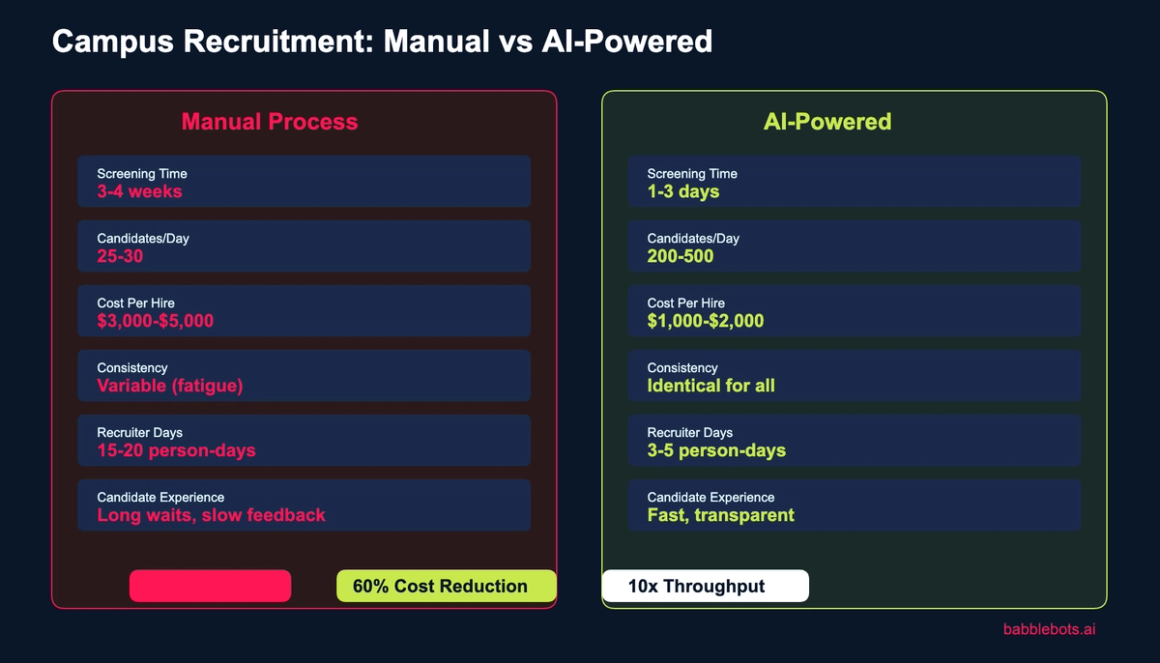
With manual processes screening 500 candidates takes 3 to 4 weeks, requires 15 to 20 person-days, handles only 25 to 30 candidates per day, produces variable consistency due to interviewer fatigue, and costs $3,000 to $5,000 per hire.
With AI the same 500 candidates are screened in 1 to 3 days, requiring only 3 to 5 person-days, handling 200 to 500 candidates per day, applying identical criteria for every candidate, and costing $1,000 to $2,000 per hire.
AI campus recruitment delivers 3x faster hiring, 60% cost reduction, and 10x screening throughput while improving evaluation consistency and candidate experience.
Diversity Impact
Reducing Unconscious Bias
AI applies identical evaluation criteria to every candidate regardless of appearance, name, or institution. Voice AI does not see candidates so appearance-based bias is eliminated entirely. Structured scoring prevents interviewer subjective preferences from dominating decisions. Anonymized evaluation removes institutional prestige bias so a candidate from a lesser-known college is evaluated on merit not school brand.
Expanding Reach
AI enables screening at campuses your team cannot physically visit extending reach to underrepresented institutions. Multilingual support reaches candidates from diverse linguistic backgrounds. The 24/7 availability means candidates in different time zones participate equally. Remote AI interviews make campus drives accessible to students with disabilities or travel constraints.
Measurable Outcomes
Organizations using AI in campus recruitment report 20 to 40 percent increase in female candidate advancement rates, 15 to 25 percent increase in candidates from underrepresented institutions, more consistent evaluation scores across different campuses and interviewers, and higher acceptance rates among diverse candidates due to faster more transparent processes.